
The SINOMECH three-in-one lamination machine showcased at our partner’s factory, paired with solvent-free laminating adhesives from Kangda—China’s top adhesive producer—delivers versatile and flexible lamination solutions. It supports high-position three-layer aluminum foil lamination with overhead unwinding, featuring a short material path that drastically reduces the risk of aluminum foil breakage. Additionally, it handles flat paper-plastic and plastic-plastic lamination. When orders for three-layer structures are scarce, the machine can switch to two-layer lamination to accommodate diverse production demands. A second three-in-one solvent-free paper-plastic laminator offers paper-plastic bonding, strip window and positioning window lamination, as well as thick sheet lamination capabilities.
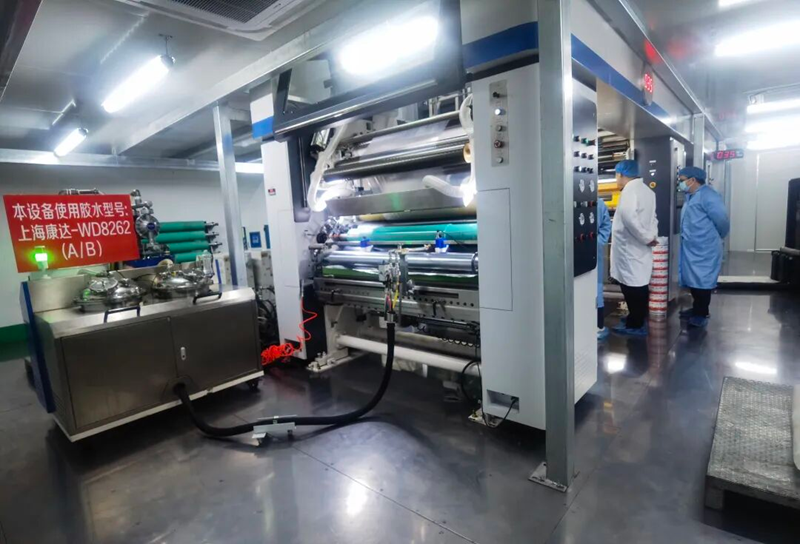
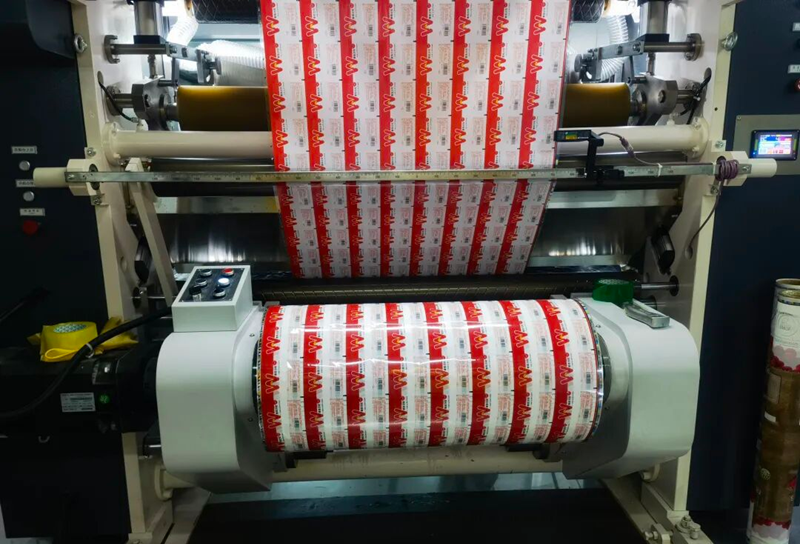
Application Showcase: High-Position Aluminum-Plastic Three-in-One Lamination
·Lamination Structure: 12μm PET / 7μm AL / 55μm PE
·Laminating Adhesive: Kangda WD8262A/B Two-Component Solvent-Free Laminating Adhesive
WD8262A/B, independently developed by Shanghai Kangda, is China’s first high-performance two-component solvent-free adhesive dedicated to aluminum foil lamination. Optimized for fully printed PET/AL composites, it leverages Kangda New Materials’ mature aluminum foil lamination technology to produce defect-free templates with zero white spots immediately after lamination. The finished films withstand retort sterilization at 121°C for 40 minutes. To align with national carbon reduction goals and mitigate environmental pollution, major flexible packaging manufacturers across China are gradually replacing dry-laminated aluminum foil products with solvent-free lamination alternatives.
Key Technical Control Points for PET+AL+PE Three-Layer Lamination Process
PET+AL+PE is a classic high-barrier composite structure. PET provides mechanical strength and printability; aluminum foil delivers core barrier functions including light blocking, oxygen resistance and water vapor insulation; the inner PE layer enables heat sealing and direct contact with contents. This structure is widely used in food, daily chemical and pharmaceutical packaging. The lamination process demands stringent precision—improper control of technical details will trigger defects such as delamination, bubbles, wrinkles, aluminum foil cracking and poor heat sealing. Below are critical process control specifications:
1. Substrate Pretreatment: Foundation of Lamination Quality
Surface performance of all substrates must be rigorously regulated.
• PET films require corona treatment to meet standard surface tension requirements. Dust and static electricity on the surface must be eliminated to prevent uneven adhesive coating and interlayer delamination.
• Aluminum foil is thin, soft, prone to oxidation and covered with rolling oil residues. Pre-cleaning and degreasing are mandatory, followed by corona activation to achieve a surface tension of ≥38 mN/m. Aluminum foil with oxidation, pinholes or creases is strictly prohibited, as such flaws will irreparably compromise barrier performance.
• Inner PE films must be fully dried with moisture content controlled below 0.05% to avoid whitening and bubbling post-lamination. Surface precipitates shall be removed to ensure stable adhesion.
2. Graded Tension Control During Production (Top Priority)
A differentiated constant tension principle must be implemented for each layer:
• PET features high rigidity; unwinding tension is set at 90–110 N with steady, uniform running speed to maintain flat film surfaces free of deviation.
• Aluminum foil has poor ductility and stretches easily under tension. Low, stable tension of 40–70 N is required. Machine startup, shutdown and speed adjustment must be gradual to avoid micro-cracks and tensile deformation caused by instantaneous pulling force.
• Soft PE films require low tension settings to prevent post-stretching shrinkage, which leads to finished product warpage and interlayer separation. Winding tension adopts a gradient decreasing profile to avoid core wrinkles and material slippage.
3. Precise Matching of Coating and Lamination Parameters
Dry lamination is the preferred process with compatible two-component polyurethane adhesives. Strict control of adhesive mixing ratio and viscosity ensures excellent leveling performance.
• Uniform coating weight is maintained at 3–5 g/m². Insufficient coating results in weak bonding strength, while excessive coating causes adhesive accumulation, blocking and residual odor.
• Fixed lamination sequence: Bond PET with aluminum foil first, cure for 2–4 hours, then laminate with PE. Simultaneous multi-layer lamination will cause uneven adhesive curing.
• Lamination temperature is stabilized at 60–80°C with moderate, uniform lamination pressure. Low temperature leads to incomplete adhesive curing; excessive temperature causes thermal deformation of films and embrittlement of aluminum foil.
4. Critical Curing and Post-Processing Specifications
Semi-finished laminated products are transferred to a constant-temperature curing room maintained at 40–50°C for 24–48 hours to enable complete crosslinking and curing of adhesives. This drastically improves interlayer peel strength and eliminates long-term delamination risks.
Slitting and bag-making operations are carried out only after full curing. Sharp hard objects must not contact the aluminum foil layer to prevent pinhole damage.
Finished products shall be stored in light-proof, dry environments away from high temperature and humidity to avoid aluminum foil oxidation and adhesive hydrolysis failure. Comprehensive dust removal is enforced throughout the workshop to prevent dust entrapment between laminated layers, which causes spot delamination and bubbles, ensuring finished products meet barrier and lamination stability standards.
Post time: Jun-25-2026