
I Industry Background: Two Mainstream Routes for Global Flexible Packaging Laminating Adhesives
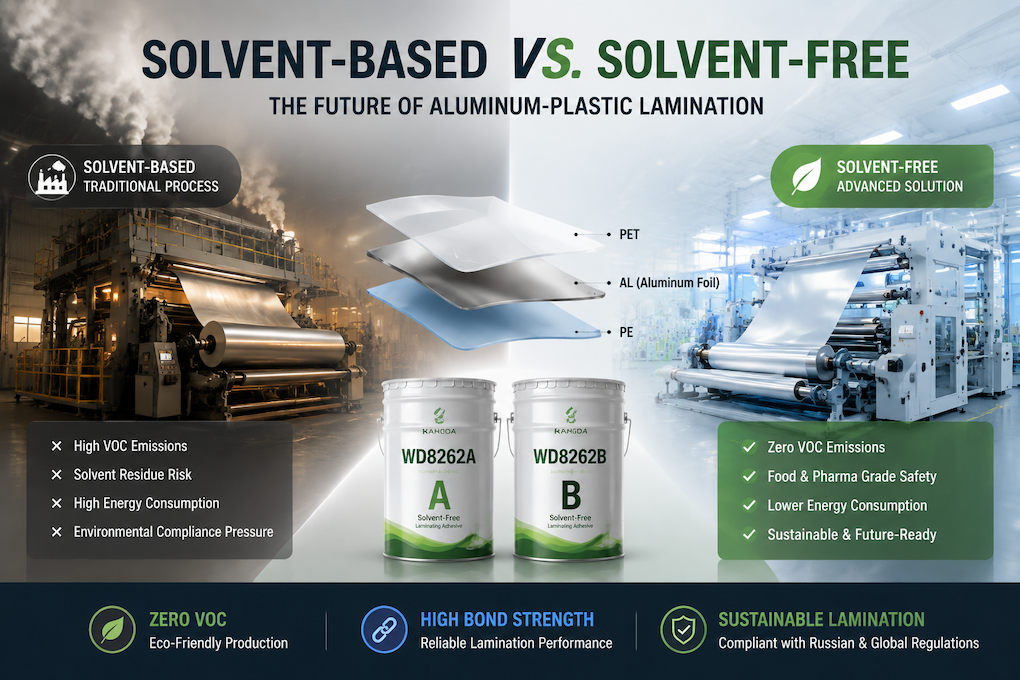
In the high-barrier flexible packaging sector for food, daily chemicals, and pharmaceuticals, the three-layer aluminum foil lamination of PET+AL+PE is the most widely used packaging structure for high oxygen resistance and light-blocking properties. The laminating adhesive directly dictates the finished product’s resistance to delamination, bubbling, and retort boiling, as well as its food safety and environmental compliance. Currently, two major systems coexist in the industry: traditional dry solvent-based polyurethane adhesives and the new generation of two-component solvent-free polyurethane adhesives. These two systems show significant differences in cost, environmental protection, product performance, and production line adaptability.
The packaging industry in the Russian and CIS markets is undergoing a transition. By 2026, the mandatory packaging recycling rate will reach 75%, while regulations regarding VOC (Volatile Organic Compounds) emissions and food contact safety continue to tighten. Numerous local packaging factories are phasing out old dry solvent-based production lines and shifting towards solvent-free lamination processes. The upcoming RosUpack exhibition in Moscow will also feature green solvent-free lamination as a core technological trend.
II Dry Solvent-Based Laminating Adhesives: Advantages and Pain Points
Core Principles
Solvent-based polyurethane adhesives have a solid content of only 30%–40% and rely on organic solvents like ethyl acetate for dilution and viscosity adjustment. After coating, they require a long oven for high-temperature drying to completely evaporate the solvent before pressing the substrates together.
1. Existing Advantages
2. Unavoidable Fatal Shortcomings
III Solvent-Free Laminating Adhesives: The Mainstream Solution
Solvent-free adhesives are a two-component polyurethane system with 100% solid content. Kangda WD8262 is China’s first specialized solvent-free adhesive developed specifically for the PET+AL+PE three-layer aluminum foil retort scenario.
1. Core Competitive Advantages
Aligns with Russia’s 2026 carbon reduction policies. Cuts energy consumption by >60% and reduces noise to 70-75dB.
Zero solvent residue. Withstands 121°C high-temperature retorting for 40 minutes. Ideal for meat, pet food, and medical bags.
WD8262 resolves insufficient foil peel strength. Optimized for 7μm thin aluminum foil to lower scrap rates.
100% active ingredient utilization. No solvent storage needed and significantly lower heating energy usage.
2. Control Points for Solvent-Free Adhesive Processes
- Substrate Pre-treatment: Corona treatment for PET; surface tension ≥38mN/m for AL.
- Differentiated Tension Control: 90–110N for PET; low 40–70N for 7μm AL to prevent micro-cracks.
- Coating and Lamination: Weight 3–5g/m². Two-step lamination process is mandatory.
- Curing Specifications: Constant temperature 40–50°C for 24–48 hours.
IV Selection Recommendations for the Russian Market
May retain dry solvent processes temporarily for short-term transitions, but must plan for exhaust modification to cope with rising environmental fees.
Highly recommended to adopt Kangda WD8262 + solvent-free machines. Solves foil cracking, delamination, and white spots.
Solvent-free attributes align with EU/Russia environmental standards, ensuring easier supply chain audits and preventing return losses.
V Future Industry Trends
The penetration rate of solvent-free lamination in the global flexible packaging market continues to climb. The 2026 Moscow RosUpack serves as a weather vane for the Eastern European packaging industry, where green solvent-free aluminum-plastic lamination technology will be the core highlight. For Russian packaging manufacturers, choosing premium domestic (Chinese) solvent-free adhesives not only reduces comprehensive costs but also proactively meets rigorous recycling and VOC control regulations, establishing a differentiated competitive advantage in the food, daily chemical, and pharmaceutical packaging sectors.
Post time: Jul-10-2026